
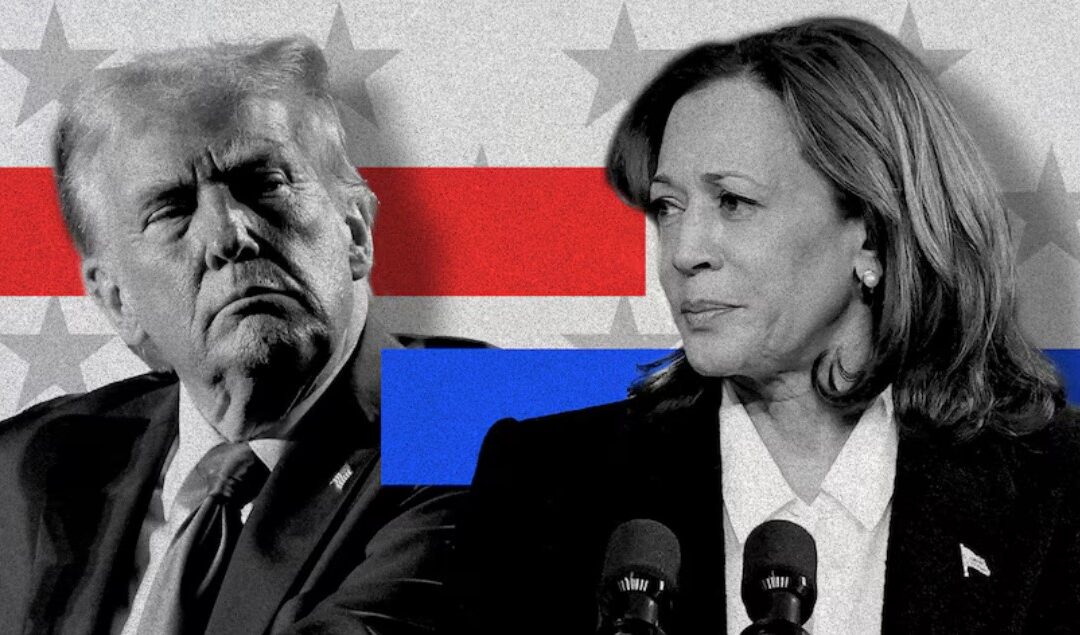
As the 2024 U.S. presidential election looms, the political landscape in America feels disturbingly divided. At the center of this division is Donald Trump, whose polarizing rhetoric and tactics have led some to draw troubling comparisons to historical authoritarian figures. Trump’s campaign, built on fear and grievance, has not only deepened the ideological rifts within the country but, alarmingly, has also raised concerns about the possibility of violence and civil unrest—echoes of the darkest moments in history.
Recent films like Civil War (starring Kirsten Dunst) and Leave the World Behind (produced by Barack Obama) serve as metaphors for the growing unease in American society. While fictional, these films eerily reflect the tensions and fractures that are threatening to tear the country apart. As Americans face the uncertainty of this election cycle, it is worth reflecting on these cultural narratives and what they reveal about the precarious state of the nation.
Could America be on the brink of its own civil war, driven by a leader who has mastered the politics of division?
The Specter of Civil War
Civil War, starring Kirsten Dunst, portrays a dystopian America where societal breakdowns and political violence become the new norm. The film taps into fears of a divided country, where ideological battles spill over into real-life conflicts, transforming the United States into an unrecognizable version of itself. While the movie is a fictional representation, the themes it explores resonate with the current climate. The rise of extremism, fuelled by Trump’s provocative rhetoric, has already led to real-world violence, such as the January 6th Capitol attack. Trump’s continued insistence that the 2020 election was stolen has only deepened distrust in the democratic process and inspired radical factions within his base.
Like the characters in Civil War, many Americans find themselves trapped in an environment of growing polarization, where dialogue and compromise seem impossible.
Trump’s campaign thrives on this division, casting his supporters as the last defenders of a nation under siege from liberals, immigrants, and “radical leftists.” It’s a narrative that mirrors the real-life anxieties of his base, who feel left behind in a rapidly changing world. This us-versus-them mentality is precisely what stokes the flames of conflict.
The question now is whether the country can pull back from the brink, or if these divisions will escalate into something more dangerous—a new kind of civil war, not necessarily fought with weapons, but with the destruction of institutions, norms, and civil discourse.
A World Left Behind
In the Netflix film Leave the World Behind, produced by Barack Obama, the focus is on a more subtle form of societal collapse. The film, set against the backdrop of an impending catastrophe, is a commentary on trust, leadership, and the fragility of modern life. As the characters are forced to confront a world that is unravelling, the story highlights how societal breakdowns happen gradually—until they don’t.
This theme of gradual collapse parallels what we are witnessing in American politics today. Trust in government, media, and institutions is at an all-time low, and Trump has played a significant role in eroding that trust.
His attacks on the legitimacy of elections, the courts, and the free press have weakened the very pillars of democracy.
In Leave the World Behind, it’s not just the disaster itself that causes panic—it’s the loss of faith in leadership and the system. People no longer know who or what to believe, and this uncertainty creates fertile ground for chaos.
Trump’s continued claims of a “deep state” conspiracy, coupled with his encouragement of violent militias, raise fears that his followers could be driven to extreme measures if he loses the 2024 election. Much like in Leave the World Behind, where characters struggle with their own moral choices in the face of a crumbling world,
Americans are grappling with how to respond to the erosion of democratic norms.
Will they stand by and watch as the system breaks, or will they take action to prevent a full-scale collapse?
Trump’s Playbook: Division and Fear
The most disturbing aspect of Trump’s current campaign is its reliance on the politics of fear. By casting himself as the only one capable of “saving” America, Trump has created an environment where dissent is viewed as disloyalty, and compromise is equated with weakness. His rallies are filled with apocalyptic warnings about what will happen if he is not re-elected, positioning him as a messianic figure who alone can stop the forces threatening the country.
This tactic—stoking fear and fostering division—is reminiscent of authoritarian leaders throughout history, including Adolf Hitler. While it’s easy to dismiss comparisons between Trump and Hitler as hyperbolic, there are undeniable similarities in their methods.
Both men rose to power by exploiting a sense of grievance and portraying themselves as the saviours of a nation in peril.
Hitler’s rise was built on scapegoating marginalized groups and undermining democratic institutions, much like Trump’s vilification of immigrants, minorities, and political opponents. The most chilling parallel, however, is Trump’s blatant disregard for the democratic process.
Like Hitler, Trump refuses to accept the legitimacy of elections he does not win, and he has repeatedly hinted that violence might be a justified response to political defeat.
In doing so, Trump has emboldened a segment of the population that views him not just as a leader, but as a symbol of their own survival. This cult of personality is dangerous because it undermines the very essence of democratic governance—the peaceful transfer of power.
Avoiding a Descent into Chaos
While comparisons to historical dictators may be uncomfortable, they serve as an important reminder of the stakes in this election. America is not immune to the forces that have led other democracies to fall. The 2024 election is not just about choosing a leader—it is about choosing a path forward for the country. Will America continue down a road of division and authoritarianism, or will it seek unity and restore faith in its democratic institutions?
The lessons from films like Civil War and Leave the World Behind are clear: once a society begins to fracture, it is difficult to put it back together. The cultural narratives in these films reflect a growing anxiety in America—a fear that we are on the brink of something irreversible. But unlike the characters in these stories, Americans have the power to change the course of history. The choice lies in whether we allow fear and division to dictate our future or whether we stand up for the values that have held the country together for centuries.
As the 2024 election draws near, the stakes could not be higher. Donald Trump’s campaign of division has set the stage for a potential crisis in American democracy, with alarming similarities to the rise of authoritarian leaders like Hitler. The question now is whether Americans will recognize these warning signs and take action to prevent a descent into chaos, or if, like in Leave the World Behind, they will wake up too late to a world that has already been lost.
This election is not just about political preferences—it is about the future of democracy itself.
The choice before us is stark: Will we embrace unity and healing, or will we let division and authoritarianism lead us down a path from which there may be no return?
America’s next chapter is yet to be written, but history and the World is watching.